
Just what it says on the tin.
Just what it says on the tin.

This is a really nice overview of SVG pros and cons.
What follows is the foreword I wrote for A Web For Everyone: Designing Accessible User Experiences by Sarah Horton & Whitney Quesenbery. If you work on the web at all, you need this book. It’s an amazingly easy read that brings humanity to an often dry subject and I am very thankful to have been a part of it.
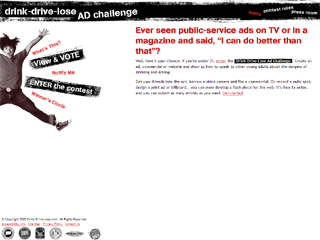
Some of you might find it hard to believe, but I began working with adaptive layouts way back in 2005. I was working on project for the Connecticut Department of Transportation and my primary design made heavy use of fixed positioning and white space. Sadly this is the only screenshot I have of the now-defunct project:
The layout really started to break down on smaller screens—we had quite a few 800x600 monitors to deal with back in the day—so, inspired by Joe Clark’s A List Apart article “Big, Stark & Chunky,” I created an alternate stylesheet that rearranged the page layout, enlarged the text, and improved the reading experience. Sadly, I don’t have a screenshot of what that looked like, but here’s a decent approximation (sans background images), courtesy of the Wayback Machine:
A recent study in of the UK came to the conclusion that over 90% of newspaper reading is still taking place in print. Their findings are based on a survey of 12 UK newspapers during the period of 2007–2011, examining National Readership Survey data, circulation audits from the Audit Bureau of Circulations, and Neilsen data regarding web-based engagement.
When you’ve been evangelizing progressive enhancement for as long as we have, you invariably come across skeptics. Take this comment on Tim Kadlec’s recent (and well-argued) post about designing experiences that work without JavaScript:
This is all fine and dandy, but not very real world. A cost-benefit analysis has to happen — what does that next user/visitor cost, and more importantly earn you? This idealistic approach would leave most broke if they had to consider “every user” when building a site. That’s why clothes come in small, medium, large, and extra large. Most of us have to buy them that way because not everyone can afford a tailor made suit, much less an entire wardrobe. Your approach only works for those who can see the return.
A while back I came across a link to Sebastiano Armeli-Battana’s jQuery Asynchronous Image Loader (JAIL) and filed it away to revisit when I had some time. I finally made some time this weekend.
{% from “macros.njk” import youtube %}
A little over a month ago I had the pleasure of speaking at Beyond Tellerrand in Düsseldorf, Germany. It was my second time speaking (and attending) the conference and I can honestly say it’s easily one of my favorites. Marc Thiele does an amazing job organizing the event and the speaker roster was nothing short of amazing.
Earlier today, Brad Frost posted a great piece touting the usefulness of interface inventories. I’ll give him the floor to explain:
An interface inventory is similar to a content inventory, only instead of sifting through and categorizing content, you’re taking stock and categorizing the components making up your website, app, intranet, hoobadyboop, or whatever (it doesn’t matter). An interface inventory is a comprehensive collection of the bits and pieces that make up your interface.
I’ll admit it: I never really got Siri.